Every mobile app marketing strategy guide that ranks on Google in 2026 is enterprise content. AppsFlyer, Branch, Adjust, Singular - they all publish 5,000 to 7,000 word guides written for marketing teams that already have an MMP, an attribution platform, and a $50K test budget. If you are an indie developer with a part-time co-founder and $200 in Apple Search Ads credit, those guides are not just unhelpful. They are actively misleading.
The truth is simpler. Indie apps grow by sequencing the lifecycle, not by collecting tactics. This post is the AAARRR funnel applied to a $0 to $1,000 monthly budget, with real Reddit-validated numbers, a 90-day playbook, and a budget-tier matrix that maps every stage to what you can actually spend. No DSPs. No 25-trend dumps. No “leverage your synergies.” Just the strategy that works when you are doing all the marketing yourself.
Q:What is the best mobile app marketing strategy for an indie developer in 2026?
A: Run the AAARRR funnel in sequence: nail ASO and your landing page first (Awareness), launch with organic content and a small Apple Search Ads budget (Acquisition), instrument onboarding before scaling (Activation), use lifecycle messaging to fix retention (Retention), build referral loops once retention is healthy (Referral), then optimize monetization (Revenue). Skip MMPs, DSPs, and paid agencies until you cross $5K MRR.
- 1.Sequencing matters more than tactics - fix ASO before paid, retention before referrals
- 2.$0 to $500/month covers Awareness + Acquisition + Activation for most indie apps
- 3.Real indie CPIs: $2 Apple Search Ads, $3-6 Meta, $1 TikTok UGC at small scale
- 4.The 90-day split: Days 1-30 foundation, 31-60 loops, 61-90 scale
- 5.ASO is the upstream input that powers Awareness AND Acquisition - not just one channel
Why the top-ranking strategy guides will sink your indie app
Open any of the top 10 results for “mobile app marketing strategy” and you will see the same shape. AppsFlyer at #2 is a 2,336 word funnel guide that assumes you can afford an MMP. Branch at #4 is a 7,000 word listicle of brand case studies featuring Sephora and Dominos. Adjust at #8 is a January 2023 article that has not been touched since before generative AI hit the App Store. Singular at #10 is a 25-trend dump where item #3 is “creative AI” and item #19 is “incrementality testing” - both useless to a developer with one app.
The structural problem is the same across all of them. They list tactics. They do not sequence them. They publish blended CPI numbers from clients who spend $50K a month, then call it “industry data.” They never tell you what to skip. And every single one assumes you already have product-market fit, money to spend, and a team to spend it with.
| Assumption | Enterprise guides | Indie reality |
|---|---|---|
| Marketing team | 5+ specialists | You, after work |
| Monthly UA budget | $10K to $200K | $0 to $1,000 |
| Attribution stack | AppsFlyer, Adjust, Singular MMP | App Store Connect + a spreadsheet |
| Channel mix | DSPs, programmatic, OTT, CTV | ASO, ASA, Reddit, TikTok |
| Time horizon | Quarterly OKRs | This weekend |
| Definition of success | $10M ARR | Replace your day job |
Top reply on 'How do yall market your apps?'
“There are multiple options here but every marketing strategy comes down to paid and unpaid marketing. Paid marketing saves time and unpaid marketing saves money.”
That tradeoff - time versus money - is what every honest indie marketing strategy comes back to. If you have neither, you cannot ship. If you have both, you do not need this guide. Most of us are somewhere in the middle, and the AAARRR funnel is how we figure out which lever to pull next.
The AAARRR funnel: a lifecycle for apps without a marketing team
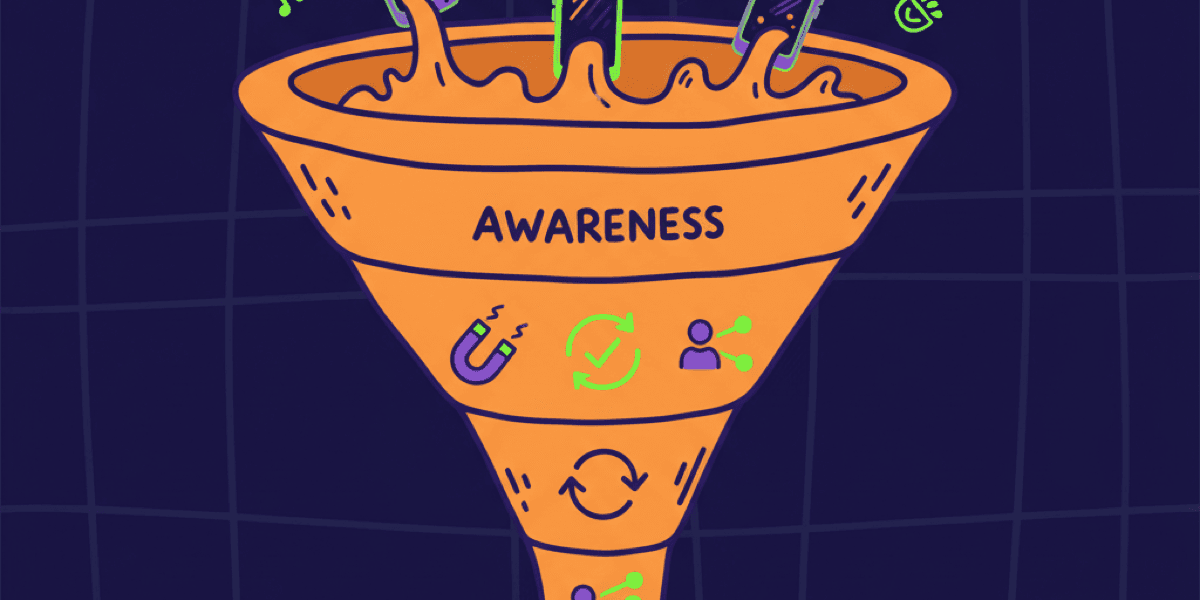
AAARRR (sometimes called the pirate funnel) is six stages a user passes through with your app. Each stage has its own metric, its own cost, and its own playbook. The point of using it as a framework is that it forces you to fix the stages in order. You cannot drive Acquisition if your Awareness is broken. You cannot scale Acquisition if Activation is leaky. You cannot grow through Referral if Retention is dead. Every stage depends on the one above it.
Awareness
People learn your app exists. The metric is impressions. The cost is mostly time. The dominant lever for indie apps is ASO (keyword rankings, App Store search) plus content (Reddit, TikTok, build-in-public).
Acquisition
People install your app. The metric is installs. The cost is paid CPI plus organic time investment. Channels: App Store search (organic), Apple Search Ads, Meta, TikTok, web2app funnels.
Activation
People reach the moment your app delivers value. The metric is your activation event (first save, first session over 60 seconds, first paid feature use). The cost is product work, not ad spend.
Retention
People come back. The metric is D1, D7, D30 retention. The cost is product work plus a small lifecycle messaging stack (push, email). This is the stage that decides whether paid UA ever pencils out.
Referral
Users bring other users. The metric is k-factor (invites sent multiplied by accept rate). The cost is product design, not incentives. Mechanic-driven referrals beat $5 credits every time.
Revenue
People pay you. The metric is ARPU and LTV. The cost is paywall design, pricing experiments, and trial mechanics. Revenue is the stage that finally lets you scale paid acquisition profitably.
This is the spine of the rest of the post. Every section below maps to one stage. Every recommendation is anchored to what an indie can actually do at that stage. We will end with a budget-tier matrix that cuts through all of it.
Awareness: make people know you exist (without buying ads)
Awareness is the cheapest stage to optimize and the one most indie developers neglect because it does not feel like marketing. It is not a campaign. It is a long, boring grind across two channels: the App Store search results, and whatever public surface your target users hang out on.
On the App Store side, Awareness is governed by ASO. Your keyword rankings, your title and subtitle, your conversion rate from impression to install. Every single install you get without paying for it starts with a search query, a category browse, or a featured slot. All three are downstream of how well you have optimized the 100-character keyword field, your screenshots, and your description. We covered the field deeply in our guide to the 100-character App Store keyword field, and the cross-store rules in our app description architecture guide.
On the public web side, Awareness is build-in-public plus content. Reddit, X, TikTok, LinkedIn, Hacker News, indie newsletters. The rule that works for indie devs is the same one that works for any community: be useful in public, be visible while you are useful, and mention your app sparingly enough that people stop noticing the mention.
Indie dev sharing what actually moved the needle
“honestly content marketing has been my biggest winner. i spend time on reddit, linkedin, twitter etc just being genuinely helpful and occasionally mentioning what im working on. find subreddits where your target users hang out... actually help people first. like really help them, dont just pitch.”
Pick one platform and own it
Reddit if your audience reads, TikTok if they watch, X if they argue. Spreading across all three is how you ship nothing on any of them.
Post 3 times a week, mention your app once
Useful posts about the niche, not your app. Replies in threads about adjacent problems. The app gets a quiet mention in your bio plus an occasional tasteful drop in a thread where it actually answers the question.
Optimize ASO before you start any of this
If your App Store listing leaks, every share you generate sends people into a broken funnel. Title, subtitle, keyword field, first three lines of description, screenshots in that order.
Run a single TikTok or Reddit experiment per week
One genuine post or video that tries to teach something or share a build update. Track which formats lead to App Store traffic via App Store Connect's Source Type breakdown.
Acquisition: convert awareness into installs
Once people know you exist, Acquisition is about converting that Awareness into App Store opens and installs. There are three buckets worth your time as an indie: organic search on the App Store, paid on Apple Search Ads, and paid on Meta or TikTok at small scale. We wrote the channel deep-dive separately - this section ranks them by what to start with. For the full breakdown, see our user acquisition channel-by-channel deep dive.
| Channel | Indie CPI | Effort | Scale | Start when |
|---|---|---|---|---|
| App Store organic search | $0 | Medium ongoing | Unlimited | Day 1 |
| Apple Search Ads (Discovery) | $0.30 to $2.50 | Low | Medium | Week 2 |
| Apple Search Ads (Exact match) | $1.50 to $4 | Low | Medium | Week 4 |
| Meta Ads | $3 to $6 | High | High | $5K MRR |
| TikTok UGC | $1 to $3 | High creative | High | $5K MRR |
| Google App Campaigns | $2 to $5 | Medium | High | $5K MRR |
| DSPs / programmatic | Varies | High | Massive | Never (skip) |
The order matters. App Store organic search is free and starts compounding the day you publish. Apple Search Ads Discovery campaigns are a sandbox where Apple matches your app against any query and returns a real CPI you can optimize against. Meta and TikTok are powerful but punishingly expensive at indie scale - you need at least $500 a month to give the algorithm enough signal to learn.
Reality check on paid acquisition unit economics
“Lots of people will say ads. You'll end up paying $3-6 per install. Make sure your app can make that back on the backend.”
That quote is the unit-economics test every indie should run before burning budget. If your app monetizes at $4 ARPU over the first 60 days, you cannot pay $5 to acquire a user and survive. The fix is almost never to find cheaper ads. It is to fix Activation and Retention so a $5 install pays back $10 within 90 days.
Indie dev struggling because ASO foundation is broken before running paid
“I've also been using the apple searchads at $2 CPI and I don't think it's doing much. Currently reworking my videos and screenshots a bit hoping that will help. Main issue is my app is waaaaaay down (like three pages down) on very pointed keyword searches.”
Read that twice. The dev is paying for installs while their app is three pages down on keyword searches. Apple Search Ads on broken ASO is paying retail for traffic that should be free. The fix is to finish ASO first, then turn ads on. Sequencing.
⚠️ What to skip at indie scale
DSPs, programmatic ad networks, mobile measurement partner (MMP) integrations, paid attribution platforms, growth agencies on retainer, and any channel where the minimum monthly spend is over $1,000. None of them work below $5K MRR. All of them are aggressively marketed to indie devs. Save your money.
Practical ASO-first advice on a $0 budget thread
“Focus on your ASO first, that's free so you won't be spending any money on that. If you nail the ASO part, you'll see a considerable change in the amount of downloads you get.”
Activation: the first-open gauntlet
Activation is where most indie apps quietly die. You spent weeks on ASO, you bought $200 of Apple Search Ads, you got 500 installs. Then 80% of them open the app once and never come back. The metric that matters here is your activation event - the moment a user does the thing that makes your product valuable. Define it, measure it, and get more users to it.
Define your activation event
Pick one specific in-app action that correlates with retention. Notion's was 'edit a page within 30 minutes.' Duolingo's was 'finish lesson 1 on day 1.' Yours should be one event you can fire from analytics.
Strip onboarding to two screens or fewer
Every screen between launch and the activation event is a place users drop. If your onboarding has 6 screens, half your users never see screen 4. Cut value props, save the email signup for after the first session.
Delay the rating prompt
Asking for a 5-star review before the user has experienced value is how you get a 1-star review. Wait until after the activation event has fired at least twice.
Track funnel drop-off weekly
Install -> open -> screen 1 -> screen 2 -> activation event. Every Monday, look at the leakiest step. Fix one thing per week. Most indie apps can double activation in 4 weeks of focus.
The unstated truth about Activation
No marketing budget can save bad onboarding. If 80% of installs never reach your activation event, doubling spend just doubles the waste. This is the only stage of the funnel where the fix is purely product work, not marketing tactics. It is also the stage with the highest leverage - lifting activation from 20% to 40% effectively halves your CAC overnight.
Retention: the stage that makes every other stage pay off
Retention is the stage that decides whether paid acquisition ever works. If your D30 is 5%, every paid dollar evaporates within the first month. If your D30 is 25%, you have a real business. The metric set you care about is D1, D7, D30 - the percentage of users still active 1, 7, and 30 days after install.
These benchmarks are wide because retention varies enormously by category. Photo apps and games skew higher on D1, lower on D30. Productivity apps skew lower on D1, higher on D30 because they are habit-forming. Whatever your category, if your D7 is below 10%, fix Activation before you do anything else. Retention work pays off on users who already activated.
The lifecycle messaging stack at indie scale is simple: a welcome push 24 hours after install, a re-engagement push at day 3 if the user has not opened, an email at day 7 if you collected one. That is the entire stack. You do not need Braze. You do not need Iterable. Apple Push Notification Service plus a basic email tool gets you 90% of the way.
⚠️ The push notification trap
Indie devs who discover push notifications tend to send too many. One push every 3 days is a habit. One push a day is uninstalls. Three pushes a day gets you reported. Treat push as a privilege the user can revoke instantly, because they can.
Referral: built-in virality on a $0 budget
Most indie referral programs fail because they bolt a “share with a friend, get $5 credit” widget onto an app no one is excited to share. Mechanic-driven referrals work better. Make the artifact your app produces inherently shareable, and the user’s natural use of the product becomes the referral channel.
Mechanic-driven vs incentive-driven referrals
Pros
- ✓Mechanic-driven costs $0 in user incentives
- ✓Mechanic-driven scales with usage, not budget
- ✓Mechanic-driven creates content you do not have to promote
- ✓Mechanic-driven referrals are inherently genuine - users are not paid
Cons
- ✗Incentive-driven works only when LTV minus CAC exceeds the credit cost
- ✗Incentive-driven attracts gamers and resellers more than real users
- ✗Incentive-driven requires fraud prevention engineering
- ✗Incentive-driven dies the moment you turn off the budget
Examples of mechanic-driven referrals: PhotoRoom watermarks free edits with their logo, every export is a referral. Wordle was a URL that produced a colored grid users could not resist sharing. Strava publishes routes as auto-shareable maps. Notion lets you publish any page as a public URL. The product itself is the marketing channel.
For most indie apps, the highest-leverage referral surface is the App Store rating section. A 4.7+ rating with 200+ reviews is a better conversion-rate optimizer than any landing page tweak. Ask for ratings after the activation event, not before. Use Apple’s native SKStoreReviewController so the prompt counts toward your actual rating. We covered the timing problem in detail in our App Store review popup guide.
Revenue: pricing, paywalls, and the monetization-UA loop
Revenue is the stage where you finally answer the unit-economics question every Reddit thread asks: can my app pay back $3 per install within 90 days? The levers at this stage are pricing tier, paywall placement, trial mechanics, and the choice between subscription, one-time purchase, and IAP.
Annual Cost Comparison
You'd save $12/year with Free + ads
You'd save $48/year with Free + ads
You'd save $72/year with Free + ads
You'd save $108/year with Free + ads
You'd save $228/year with Free + ads
Monthly-equivalent ARPU per active subscriber. Weekly and lifetime tiers tend to maximize early revenue, annual maximizes retention.
For indie apps, the pattern that has emerged in 2025-2026 is a weekly-plus-annual paywall: weekly to capture impulse buyers at the first session, annual to lock in committed users. Monthly is the worst-performing tier at every price point and should generally be skipped. Lifetime works for utility apps with low ongoing cost.
The Revenue stage is also where you re-evaluate paid acquisition. Once your blended ARPU over 90 days exceeds your blended CPI, Apple Search Ads becomes profitable and you can scale spend with confidence. Most indie apps hit this milestone after fixing Activation and Retention - not by finding cheaper ads.
The 90-day indie marketing strategy playbook
Here is the AAARRR funnel as a calendar. Three 30-day blocks. Each block has one focus stage and one or two supporting stages. If you are launching a new app, start at Day 1. If you have an existing app that is not growing, start at Day 31 and audit your foundation first.
Days 1 to 30: Foundation
Lock in ASO (title, subtitle, keyword field, first 3 lines of description, screenshots). Ship a landing page. Pick one community platform and start posting 3x/week. Activate analytics and define your activation event. Goal: 100 organic installs and a defined funnel.
Days 31 to 60: Loops
Run an Apple Search Ads Discovery campaign at $5 to $10/day. Add lifecycle messaging (welcome push, day-3 re-engagement). Optimize onboarding to lift activation. Add ratings prompt after activation event. Goal: D7 above 15% and Activation above 40%.
Days 61 to 90: Scale
Move ASA from Discovery to Exact-match on top keywords. Test Meta or TikTok if MRR is over $1K. Implement a referral mechanic. Run a paywall test (annual + weekly vs monthly + annual). Goal: blended CAC below 90-day ARPU.
Indie budget tiers: what to spend at each stage
Every recommendation above maps to a budget tier. Here is the matrix every enterprise guide refuses to publish: what each AAARRR stage looks like at $0, $100-$500, $500-$2K, and $2K+ per month. Pick the column you are in and ignore the rest.
| Stage | $0/month | $100-$500/month | $500-$2K/month | $2K+/month |
|---|---|---|---|---|
| Awareness | ASO + 1 social platform | + scheduling tool ($15) | + paid content distribution | + PR retainer or influencer seeding |
| Acquisition | Organic only | ASA Discovery $5-15/day | ASA Exact + Meta test | Multi-channel paid mix |
| Activation | Manual onboarding tweaks | Same | + A/B test infra ($50) | + analytics tooling (Mixpanel) |
| Retention | APNs + email | Same | + lifecycle tool ($100) | + paid customer success |
| Referral | Mechanic-driven only | Same | + small referral incentives | + ambassador program |
| Revenue | Paywall + RevenueCat | Same | + pricing experiments | + pricing/paywall consultancy |
Annual Cost Comparison
You'd save $2400/year with Tier 0 (organic only)
You'd save $12000/year with Tier 0 (organic only)
You'd save $36000/year with Tier 0 (organic only)
Most indie apps live in Tier 0 or Tier 1 for the first 12 months. Tier 2 is unlocked by retention, not by finding extra cash.
First-app launcher sharing what worked in week 1
“Don't be afraid to talk about it to your network. Post about it on all your social media channels, ask your friends to post about it, hell even put up fliers around your neighborhood! And ask everyone you know to give it a review.”
That quote is Tier 0 in action. Friends, network, social, reviews. It costs nothing and it works for the first 100 to 500 users. Anyone telling you you need a paid budget on day one is selling you something.
Where ASO fits in every stage of your strategy
Notice what showed up in nearly every section above. Awareness is ASO plus content. Acquisition starts with App Store organic search. Activation depends on whether your screenshots and description set the right expectation. Retention is partly a function of whether the app you delivered matches the keyword that brought the user in. Even Revenue is downstream - if you cannot rank for high-intent keywords, paid acquisition cannot pencil out.
That makes ASO the upstream input to the entire funnel. Keyword research is not a Tier 1 channel decision. It is the foundation every other strategy in the lifecycle is built on. The ranked keywords you target inform your title and subtitle, your ad creative, your landing page copy, and the categories your app appears in. Get this wrong and every downstream stage compounds the error.
The infrastructure that powers Awareness and Acquisition
ASO Maniac handles the keyword research with AI suggestions, popularity scoring (1-100), rank tracking across iOS and Google Play, competitor analysis, and an MCP server for AI-agent workflows. Indie-priced, built for the developer running the whole funnel solo. Visit https://asomaniac.com to start.
For the channel-level deep dive on UA, see our user acquisition channel-by-channel guide. For the wider discovery surface map, see our piece on the 8 channels most developers ignore. If you are still validating an idea before any of this, start with how to validate your app idea with keyword data. And the web side of the funnel - landing pages, smart banners, UTM tracking - is covered in our mobile app landing page guide. The full ASO tooling comparison lives in our best ASO tools comparison.
The 90-day launch audit
Use this checklist as a single-page audit of where you are in the funnel. If any item is unchecked, that is the next thing to fix before adding budget anywhere else. The order matches the AAARRR stages on purpose.
🎯Indie app launch audit
Tick what is done. The lowest unchecked item is your next focus.
App Store title and subtitle use a high-popularity primary keyword
100-character keyword field is filled and de-duped against title
First 3 lines of description sell the value before See More
Screenshots have annotations and tell a story across 5 frames
Landing page exists with App Store badge and UTM-tagged links
Posting on one chosen community platform 3x/week
Activation event is defined and fires from analytics
Onboarding is 3 screens or fewer
Welcome push fires 24 hours after install
Day-3 re-engagement push exists for non-openers
Rating prompt fires after activation event, not before
Paywall is weekly + annual, not monthly + annual
Apple Search Ads Discovery campaign is running at $5-15/day
D7 retention is above 15%
Blended 90-day ARPU exceeds blended CPI
Summary
The difference between indie apps that grow and indie apps that die is sequencing, not tactics. Every ranking enterprise guide treats marketing as a tactic dump - 8 strategies, 25 trends, 12 channels - and skips the question of which order to do them in. The AAARRR funnel forces the order: Awareness, Acquisition, Activation, Retention, Referral, Revenue. Fix each stage before scaling the next.
For an indie developer in 2026, that means ASO and a landing page first, organic content second, a small Apple Search Ads test third, Activation fixes fourth, lifecycle messaging fifth, referral mechanics sixth, paywall optimization seventh, then maybe Meta or TikTok at month four. Skip MMPs, DSPs, and growth agencies until you cross $5K MRR. The 90-day playbook above is enough to grow most indie apps to that point. Anyone selling you a faster path is selling you their product.
Run the funnel. Trust the order. The compounding kicks in around month three.