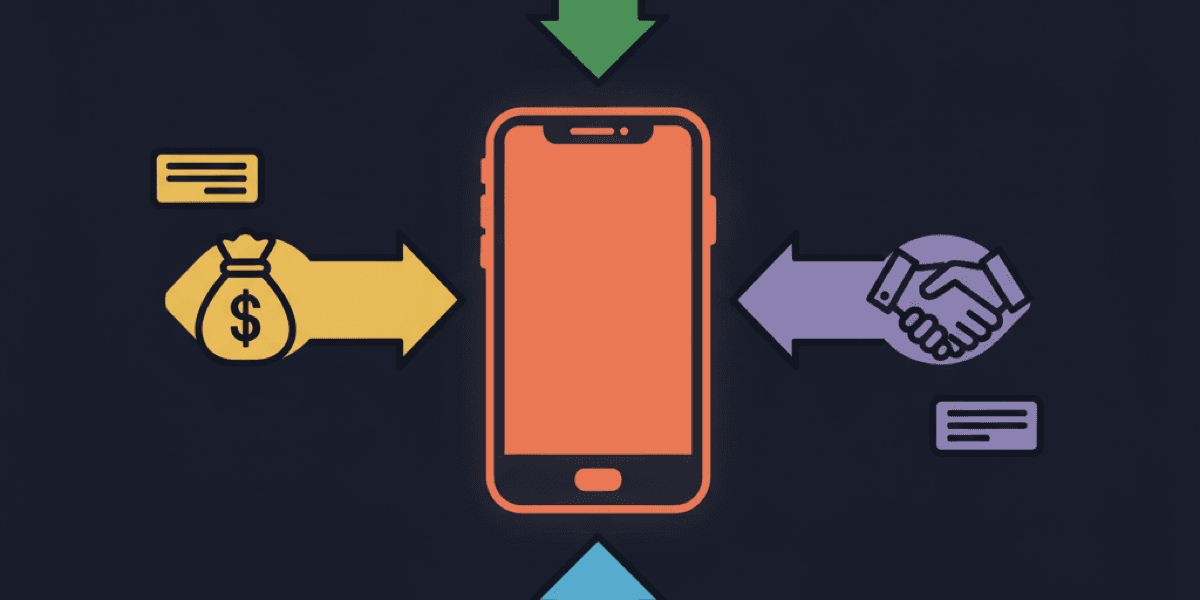
Every mobile app user acquisition guide that ranks on Google falls into one of two buckets. The first is a glossary page (Adjust, Singular, Unity) that defines UA in 1,000 words and tells you to use their attribution platform. The second is an 8,500-word channel dump (AppsFlyer) that lists Facebook, Google App Campaigns, Apple Search Ads, DSPs, and Snapchat as if a solo developer with a $200 budget and a marketing team with a $200K budget would pick the same one.
Both miss the indie reality. If you are reading this with a small budget and no marketing team, you do not need eight channels. You need a ranking by cost, effort, and scale, and you need real numbers. So this guide ranks every UA channel, publishes real CAC and CPI benchmarks (with Reddit-validated quotes), and ends with a budget-tier decision framework. Organic UA is ASO. We are going to make that explicit.
Q:What is mobile app user acquisition?
A: Mobile app user acquisition (UA) is the process of getting people to install your app and become active users. There are four channel categories ranked by cost: organic (ASO + content + SEO, $0 CAC), community (Reddit + niche communities, $0 CAC), paid (Apple Search Ads, Meta, Google App Campaigns, TikTok, $1-$10 CPI), and partnerships (cross-promotion, influencers, variable). For indie developers under $500/month, ASO + Apple Search Ads + niche communities deliver the lowest blended CAC.
- 1.Organic UA on the App Store IS ASO - keyword research and rank tracking are UA infrastructure
- 2.Apple Search Ads is the lowest-CPI paid channel for indie iOS apps ($0.30-$2.50 per tap)
- 3.Reddit and niche communities convert better than paid social for early-stage apps
- 4.Meta and Google App Campaigns need $500+/month minimum to learn
- 5.Web2App funnels are the 2026 advanced tactic enterprise blogs miss
What is mobile app user acquisition (and why most guides get this wrong)
User acquisition is everything you do to turn a stranger into someone who installs your app. That is a wide net. It includes paid ads, App Store ranking, blog posts, Reddit replies, App Store featuring, deep links, partnerships, and community building. Most UA guides treat all of this as one bucket. We split it into four tiers, ranked by what an indie developer can actually afford.
The 4-tier UA framework looks like this:
- Tier 1: Organic UA. ASO, SEO, content marketing. Zero direct CAC. Compounds over time. Slow start.
- Tier 2: Community UA. Reddit, niche forums, indie communities. Zero CAC but high time investment. Highest-trust installs.
- Tier 3: Paid UA. Apple Search Ads, Meta, Google App Campaigns, TikTok. Predictable cost. Scales with budget.
- Tier 4: Partnerships. Cross-promotion, influencers, App Store featuring. Highest leverage, lowest control.
The mistake every glossary page makes is treating Tier 3 as the entire topic. The mistake AppsFlyer makes is treating all paid channels as equivalent. The mistake every indie developer makes is jumping straight to Tier 3 with a $50 budget and burning it.
The unstated insight: organic UA on the App Store is ASO
Every install you get without paying for it comes from someone discovering your app on the App Store, on the web, or in a community. The App Store discovery surface is governed by ASO (keyword rankings, screenshots, conversion rate). That makes ASO the foundation of any indie UA stack. ASO Maniac is the keyword research and rank tracking infrastructure for that foundation. See https://asomaniac.com to start.
The UA channel map: cost vs effort vs scale
This is the table no enterprise UA blog will publish. Every channel, ranked by cost, effort, and scale ceiling, with a one-line verdict on who it is for. CPI numbers come from Reddit threads (2024-2026) and public benchmark reports.
| Channel | Cost (CPI) | Effort | Scale | Best for |
|---|---|---|---|---|
| ASO (organic) | $0 | Medium (ongoing) | Unlimited | Every indie app |
| SEO / content | $0 | High (months) | Unlimited | Apps with web hooks |
| Reddit / niche communities | $0 | High (daily) | Limited | Early stage, $0 budget |
| Apple Search Ads | $0.15-$2.50 | Low | iOS only | Indie iOS, $100+/mo |
| TikTok Ads | $1-$5 | High (creative) | Massive | Apps with social hook |
| Google App Campaigns | $1-$5 | Low | Cross-platform | Android-first, $500+/mo |
| Meta Ads | $1-$10 | High (creative) | Massive | Scale players, $1K+/mo |
| Cross-promotion | Variable | Low (after deal) | Bounded | Apps with retention |
| Influencers | Variable | Medium | Bounded | Apps with social proof |
UA channels ranked by cost, effort, scale, and fit for indie budgets
The pattern is clear. The cheapest channels (ASO, communities) take the most ongoing effort. The most predictable channels (Apple Search Ads, Google) need budget to learn. The biggest scale channels (Meta, TikTok) need creative and budget to compete. There is no free lunch, but there is a right place to start for every budget.
Tier 1: Organic UA - the ASO foundation
Organic UA on the App Store is ASO. Period. Every install you do not pay for comes from someone typing a keyword into App Store search, scrolling a category, or tapping a “you might also like” suggestion. All three are governed by your keywords, your icon, your screenshots, your ratings, and your conversion rate. That is ASO.
Direct validation that ASO + Reddit is the early-stage UA stack
“ASO and niche distribution usually work best early on because they compound over time. keywords and clear screenshots keep bringing in users, and Reddit can help too if you're active and genuinely a part of the community. Paid Ads and Product hunt can also help but again you need to have some presence first.”View on Reddit
Why organic UA equals ASO for the App Store
The App Store is a closed search engine. Apple controls 100% of the discovery surface. The web has Google, Bing, Reddit, Twitter, and a thousand other paths to your site. The App Store has search, charts, categories, editorial, and “you might also like.” Three of those five are direct ASO outputs. One is editorial (out of your control without a relationship). One is rank-driven (which is ASO).
That means an indie developer with $0 in ad spend has exactly one organic UA lever: ASO. Ranking for high-volume keywords, converting searchers into installs, and stacking ratings to boost both. Everything else (blog posts, SEO, Reddit) feeds into that loop.
Keyword research and rank tracking as UA infrastructure
You cannot do ASO without two things: a keyword list with real popularity data, and a rank tracker that tells you which keywords you already win. Most indie developers skip both. They guess at keywords, stuff their App Store metadata, and never check if it worked.
Pull seed keywords from your category
Start with 50-100 keywords your target users would search. Mix branded, problem, and use-case terms. Score them by search volume.
Filter by popularity score
Anything below a popularity score of 20 is too niche. Anything above 80 is too competitive for a new app. Sweet spot is 30-60 with rising trends.
Apply keywords to your metadata
Title (30 chars), subtitle (30 chars), keyword field (100 chars on iOS), description (Google Play). Each surface treats keywords differently.
Track rankings weekly
Check your position for every target keyword. New keywords usually take 2-4 weeks to settle. Drop the ones that never break top 50.
The ASO loop that drives organic UA
ASO Maniac: keyword research and rank tracking for indie apps
ASO Maniac handles the keyword research, popularity scoring (1-100), rank tracking across iOS and Google Play, and competitor analysis that makes organic UA measurable. AI-powered keyword discovery, MCP server for AI agents, REST API for custom workflows, multi-country coverage. Indie-priced vs enterprise alternatives. Visit https://asomaniac.com to start.
Tier 2: Community UA - Reddit, niche forums, and indie hackers
Community UA is the second-cheapest channel after ASO. Cost is $0 in cash. Cost is high in time and credibility. Done right, it produces the highest-quality early users you can find: people who arrived because someone they trust mentioned your app in a thread about their problem.
The 'help first, mention second' rule that works on Reddit
“honestly reddit is quietly the best place for early growth if you dont act like a marketer.. finding subreddits where people are literally complaining about the problem you solve and just offering a helpful tip with a mention of the app works so much better than cold outreach.. its all about being a person first and a founder second.”View on Reddit
How to use Reddit without getting banned
Reddit will ban you instantly if you join, post your app, and leave. Every subreddit has different self-promo rules, but the universal rule is: contribute first. The ratio that works is 9:1 (helpful comments to promotional ones), and even your one promotional comment should be a relevant mention inside a helpful answer, not a standalone “check out my app” post.
✅Community UA checklist
Run this before you mention your app anywhere
Pick 2-3 subreddits where your target users genuinely hang out
Post 10+ helpful comments before any self-promo
Search the sub for posts where users complain about your problem
Reply with a real solution first, mention your app second
Read each sub's self-promo rules (some allow only on weekly threads)
Track which subreddits drive installs vs which just upvote
⚠️ Self-promo bans are permanent
Reddit moderators can shadow-ban your account, your domain, and your app's name across an entire subreddit network. Once banned, you do not get unbanned. Treat every Reddit account like a long-term reputation, not a marketing channel.
Niche communities beyond Reddit
Reddit is the obvious one, but the same logic works for Indie Hackers, Hacker News, Designer News, Product Hunt’s “ship” feed, niche Discord servers, Slack communities, and Facebook groups. The pattern is identical: become a real participant, then mention your app when it is genuinely relevant. The smaller and more specific the community, the higher the conversion rate per mention.
Tier 3: Paid UA - channel-by-channel reality check
Paid UA is where indie developers waste the most money. The rule is simple: paid channels need budget to learn. If you cannot put $30-$50 a day into a channel for 2-4 weeks, the algorithm will not optimize for you and the CPI will look terrible. The only paid channel where $5-$10 a day works is Apple Search Ads.
Apple Search Ads (best paid channel for indie iOS)
Apple Search Ads (ASA) is the only paid channel built for indie iOS budgets. You bid on App Store keywords, your ad shows above search results, and you pay per tap. No SDK is required. No MMP attribution platform is needed. Apple self-attributes installs because they own the entire funnel.
Real ASA CPI from an indie iOS developer in Asia
“I am able to get roughly $0.30 to $0.15 CPI. But, mine is mostly focus in middle income countries in Asia. Currently, I only advertise in Apple Search Ads. Primary reasons is that 1. I believe Apple Search Ads will provide lowest CPI compared to other networks, due to less friction/layers to drive an install. 2. No additional MMP SDK required. As far as I know, MMP SDK is expensive.”View on Reddit
Meta Ads (Facebook + Instagram)
Meta is the largest mobile ad network by spend. It is also the most punishing for indie budgets. The algorithm needs significant data to optimize, and iOS 14.5+ tracking limits made that worse. If you have less than $1,000/month, expect ugly CPIs. With serious spend and good creative, the floor drops dramatically.
Meta Ads work at scale, painful at indie budgets
“Facebook ads.... you do need money to test. The more money you spend the cheaper your cpi gets as Facebook can optimise better when you spend more. I have worked with companies where the spend was in millions of euros and we brought our cpi down to .20 - .25 cents in Germany.”View on Reddit
Google App Campaigns
Google App Campaigns (GAC) reach across Search, YouTube, Google Play, and the Display network. They are largely automated, which is good for time-poor developers and bad for visibility. You set a target CPI and a daily budget; Google figures out where to show your ads. CPIs run $1-$5 in most categories.
TikTok Ads
TikTok is the youngest paid channel and often the cheapest at small budgets, especially for apps with a social-friendly hook. The catch is creative. TikTok ads need to look native (vertical video, UGC style, not corporate). If you can produce or buy native content, CPIs in the $1-$3 range are realistic.
Reality check: CPI benchmarks for small indie spend
Real CPI from a small mixed Google + FB spend
“ran paid ads on google & fb got like 150 installs for $2.8 cpi not great but better than reddit posts.”View on Reddit
Annual Cost Comparison
Realistic monthly minimums to actually learn from each paid channel
⚠️ MMP SDK costs add up fast
Mobile Measurement Partner platforms (AppsFlyer, Adjust, Singular) charge per attributed event and per MAU. For a small indie app, this can run $200-$1,000/month before you have spent a dollar on actual ads. Apple Search Ads and Google App Campaigns self-attribute, so you can start without an MMP. Add one only when you scale across multiple paid channels.
Tier 4: Partnerships - cross-promotion, influencers, and featuring
Tier 4 is the most leveraged and least controllable category. A well-placed feature, an influencer mention, or a cross-promotion deal with a non-competing app can deliver thousands of installs at near-zero marginal cost. The catch is that you cannot just buy these. They take relationships, timing, and a product worth featuring.
Partnership UA: when it works and when it does not
Pros
- ✓Highest leverage per hour invested when a deal lands
- ✓Trust transfer from the partner inflates conversion rate
- ✓App Store featuring can deliver 10K+ installs in a day
- ✓Cross-promotion with a non-competitor is essentially free
- ✓Influencer mentions compound on social platforms
Cons
- ✗Unpredictable - you cannot plan a feature into a roadmap
- ✗Apple/Google featuring requires an existing relationship
- ✗Most influencers want flat fees and underdeliver
- ✗Cross-promotion requires you to already have an audience
- ✗Long sales cycles for B2B-style partnerships
Web2App funnels: the 2026 tactic enterprise guides miss
The most underrated UA pattern of 2026 is the web2app funnel. Instead of sending paid traffic directly to the App Store, you send it to a landing page first. The page educates, qualifies, and (sometimes) prices the user before they install. This sounds slower, but it usually beats install-first funnels on every metric that matters: retention, LTV, and ROAS.
The 2026 web2app funnel tactic - 100% absent from competitor SERPs
“what actually worked for me was narrowing the focus instead of chasing every channel. If you work with paid ads, especially on a decent budget, web2app funnels are worth testing early. They convert better once you understand your audience because you can educate, qualify, and price before the install, not after. ASO helps, but it won't fix a weak funnel. The biggest mistake I see is scaling traffic before retention and onboarding make sense.”View on Reddit
Building a web2app funnel
Build a focused landing page
One hook, one promise, one CTA. Show the problem you solve, screenshots of the app, social proof, and a single button to install.
Add deep linking
Use Universal Links (iOS) and App Links (Android) so users land in the right screen of your app after install. Apple Search Ads can also pass keyword context through deferred deep links.
Drive paid traffic to the landing page, not the App Store
Run Meta and TikTok ads to the page. Use the page to qualify and educate. Send only qualified clicks to the App Store. Track install events.
Layer in email capture
Even users who do not install today are not lost. Capture an email and follow up with onboarding content. This compounds your paid spend.
The thesis: ASO is the foundation, web2app is the multiplier
ASO drives free organic installs. Web2app funnels make every paid dollar work harder. They are not alternatives. Indie developers should build both. ASO Maniac gives you the keyword research and rank tracking that powers the ASO half. Visit https://asomaniac.com to get started.
Measuring UA: the metrics that actually matter
Most UA guides dump every metric you have ever heard of into one section: CAC, LTV, ROAS, ARPDAU, retention curves, cohort analysis, K factor. For an indie developer with no analytics team, three numbers matter. The rest are noise until you scale.
| Metric | What it measures | Indie target | Use it for |
|---|---|---|---|
| CAC | Cost to acquire one paying user | < 1/3 of LTV | Channel ROI decisions |
| LTV | Total revenue per user lifetime | Depends on monetization | Setting CAC ceiling |
| ROAS | Revenue per ad dollar spent | > 100% within 30 days | Paid channel scaling |
| Day 7 retention | % of users still active 7 days post-install | > 20% (varies by category) | Product-market fit signal |
| Day 30 retention | % of users still active 30 days post-install | > 10% (varies by category) | LTV foundation |
The 5 UA metrics indie developers actually need
Notice retention is on the list. That is intentional. Retention is your real UA metric. If users churn in 3 days, every dollar you spend acquiring them is wasted. Fix retention before scaling spend. This is the single most common mistake in indie paid UA.
Q:What attribution tool should an indie developer use?
A: Start with the free self-attributing channels. Apple Search Ads and Google App Campaigns both report installs natively. The App Store Connect dashboard tracks impressions, taps, and conversions. Add an MMP (AppsFlyer, Adjust, Singular) only when you run 3+ paid channels at $1K+/month and need cross-channel attribution. Until then, the cost outweighs the value.
The indie UA decision framework: where to spend your first $500
This is the framework you came here for. Pick the budget tier that matches your reality and run that stack. Do not skip tiers. A $0 developer who jumps to Meta Ads will burn $500 in a week and learn nothing. A $500 developer who skips ASO is leaving the cheapest channel on the table.
🌱$0/month: ASO + Reddit + niche communities
The bootstrapped indie stack. Free, slow, compounds.
Set up keyword research (50-100 target keywords)
Optimize App Store metadata (title, subtitle, keyword field)
Track rankings weekly
Pick 2-3 subreddits and contribute daily
Build 1-2 niche community relationships
Ship product updates that drive ratings
Annual Cost Comparison
You'd save $3600/year with $0 budget: ASO + Communities
You'd save $18000/year with $0 budget: ASO + Communities
You'd save $36000/year with $0 budget: ASO + Communities
Indie UA budget tiers - pick one and execute it before moving up
A bootstrapped team's actual UA stack - validates the multi-channel indie approach
“As a bootstrapped and small team, we do lot of aso, search ads, some social media marketing and recently started seo to get traffic from web. About the CPI $1 sounds good, but it also depends on the geo and user quality. Mostly, whether it makes sense in terms of ROI.”View on Reddit
Our Verdict
🎯The indie UA stack
For indie developers under $500/month, the answer is not eight channels. It is ASO + Apple Search Ads + niche communities. Track CAC, LTV, and Day 7 retention. Add web2app funnels when you have enough budget to run paid social. Skip Meta until you can spend $1K+/month.
Best for: Indie iOS and Android developers post-launch, with $0-$500/month budget
Strengths
- +Lowest blended CAC of any combination
- +Compounds over time as ASO rankings improve
- +Community trust drives high-retention users
- +Apple Search Ads provides predictable scaling once ASO is set
Weaknesses
- −Slow start (ASO takes 4-12 weeks to settle)
- −Requires ongoing time investment in communities
- −Will not match the volume of $5K/month paid campaigns
What to skip: common UA mistakes that burn indie budgets
Every UA guide tells you what to do. None of them tell you what to skip. That is where indie budgets actually die. Here are the four mistakes that come up over and over in the community.
Win/loss breakdown - perfect for the 'what to skip' framing
“What worked wasn't a magic channel, it was focus. One clear ICP, one pain, then showing up where those users already are. Wins: niche Reddit replies (not promos), direct outreach to users of competing tools, and talking to users before scaling anything. Misses: Product Hunt without an audience, paid ads too early, and generic 'post daily' social advice.”View on Reddit
⚠️ Skip: Product Hunt without an existing audience
Product Hunt rewards apps with pre-built audiences. If you have no email list, no Twitter following, and no community, your launch will get 50 upvotes and zero installs. Build the audience first, launch second. Or skip Product Hunt entirely and put the time into Reddit.
⚠️ Skip: paid ads before retention is solid
If your Day 7 retention is below 10%, every paid install is a dollar set on fire. Fix onboarding, fix activation, fix the first-session experience. Then turn on paid traffic. This is the single most common mistake in indie UA.
⚠️ Skip: chasing every channel at once
A solo developer cannot run ASO, Reddit, Twitter, Product Hunt, Apple Search Ads, Meta, TikTok, Google App Campaigns, and influencer outreach in the same month. Pick 2 channels per quarter and execute them well. Multi-channel mediocrity beats single-channel excellence in zero indie case studies.
⚠️ Skip: ignoring ASO until after you have spent on ads
Paid traffic to a poorly-optimized App Store page converts at half the rate of an optimized page. You are paying double. ASO is the discount that compounds. Do it first, even if you have a paid budget. Especially if you have a paid budget.
The 'do this, not that' summary
Pros
- ✓Optimize ASO before any paid spend
- ✓Pick 2 channels per quarter and execute them
- ✓Test web2app funnels with paid traffic
- ✓Track Day 7 retention as your real UA metric
- ✓Use Apple Search Ads as your first paid channel
- ✓Engage in niche communities before mentioning your app
Cons
- ✗Skip Product Hunt without an audience
- ✗Skip paid ads if Day 7 retention is below 10%
- ✗Skip MMP attribution until you spend $1K+/month
- ✗Skip Meta Ads until you can put $30-$50/day into it
- ✗Skip channel-spray strategies that try everything
- ✗Skip generic 'post daily on social' advice
Summary
Mobile app user acquisition for indie developers is not a list of eight channels treated as equals. It is a four-tier framework where you start cheap (ASO + community), add Apple Search Ads when you have $100 to spend, and only graduate to Meta or TikTok when retention is solid and budget exceeds $500/month. The cheapest channel is also the most important: ASO is the foundation that makes every other channel work better.
Real CPIs from real Reddit threads back this up: $0.30 on Apple Search Ads in Asian geos, $0.20-$0.25 on Meta only at scale, $2.80 on small Google + FB tests. Web2app funnels are the 2026 tactic enterprise guides ignore. Day 7 retention is your real UA metric. Skip Product Hunt without an audience, skip paid ads with broken retention, skip the channel spray.
Start with ASO. Use ASO Maniac for keyword research and rank tracking. Build the foundation, then layer the paid channels. The indie UA stack is not glamorous, but it compounds. For more on the keyword side, see our guides on App Store keywords and app discoverability.