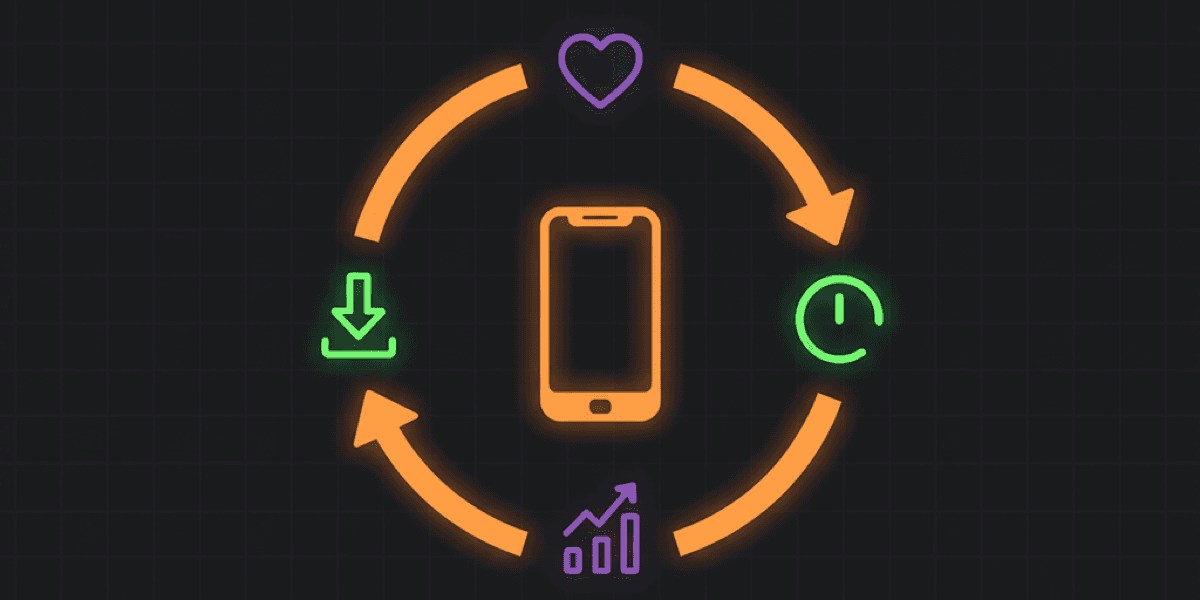
Here is the number that should keep every indie developer up at night: 74-77% of the people who install your app are gone within the first 1-3 days. You spent weeks shipping it, maybe money acquiring them, and three out of four never come back.
Every other article about this treats retention as a pure lifecycle-marketing problem: push notifications, onboarding flows, email win-back campaigns. That advice is fine, and you will find the full playbook below. But it misses half the picture. Retention is also an App Store Optimization problem on both ends. The App Store rewards engaged, retained apps with better rankings, and the keywords you target decide whether you acquire users who were ever going to stick around in the first place.
So this guide does two things no one else does together: the standard retention playbook with real benchmarks and tactics, plus the loop that connects retention back to your store rankings. Let us start with what good even looks like.
Q:What is a good mobile app retention rate?
A: Across all categories, a healthy benchmark is roughly 25% on Day 1, 11-12% on Day 7, and 4-6% on Day 30. Anything above 10% at Day 30 is outperforming, and above 15% is elite.
But benchmarks vary hugely by category. Social apps hold 15-20% at Day 30 while ecommerce apps see 3-6%, so always compare against your own vertical, not the global average.
- 1.Day 1: ~25% (the single most important number to fix first)
- 2.Day 7: 11-12% average
- 3.Day 30: 4-6% average, >10% good, >15% elite
- 4.iOS retention slightly beats Android across categories
Why retention is the only growth metric that compounds
Acquisition is a leaky bucket. You can pour installs in the top, but if most users drain out in 72 hours, you are paying to refill a hole. The first 1-3 days are where that hole is widest.
The economics are brutal in one direction and beautiful in the other. Bain's classic finding is that a 5% increase in retention can lift profit by 25-95%, because retained users cost nothing to re-acquire and compound into word of mouth, reviews, and revenue. Acquisition spend, by contrast, resets to zero the moment a campaign stops.
This is why retention beats every other growth metric you can chase. A better install does not just stay - it pulls more of itself in. Hold that thought, because it is the foundation of the flywheel we get to below.
What good retention actually looks like (benchmarks by category)
Retention is usually measured at three checkpoints. Day 1 is the share of new users who open the app the day after install, Day 7 one week later, and Day 30 a month out. D1 tells you whether onboarding lands, D7 whether a habit is forming, and D30 whether the app earned a place on the home screen.
The global averages are a starting point, not a target. A meditation app opened twice a week and a news app opened twice a day have completely different ceilings. Compare yourself to your category.
| Category | Day 1 | Day 7 | Day 30 |
|---|---|---|---|
| Social & communication | 30-35% | 18-22% | 15-20% |
| Fintech & banking | 22-26% | 14-18% | 10-15% |
| Health & fitness | 22-25% | 12-16% | 8-12% |
| Media & entertainment | 22-27% | 14-17% | 8-12% |
| Gaming | 25-30% | 10-14% | 4-8% |
| Ecommerce & retail | 18-22% | 10-13% | 3-6% |
| Cross-category average | ~25% | 11-12% | 4-6% |
Retention benchmarks by vertical (Appcues 2026, ranges shown D1 / D7 / D30)
Platform matters too, if only a little. iOS edges out Android across the board (roughly D1 25.6% vs 23.0%, D30 4.1% vs 2.6%), partly because iOS users skew toward higher-intent, paid-app behavior. Do not over-index on the gap, but do segment your own cohorts by platform before drawing conclusions.
Before you obsess over a number, ask the question a top reply on r/iOSProgramming put bluntly:
Reframing retention as a product-category question before tactics
“What's your app's purpose? Is it something people use every day, like calculator or news feed? Or something that people use once in a lifetime?”
A tax-filing app that gets used once a year is not failing because its D30 is low. Set your expectation by use frequency first, then chase the benchmark that actually applies.
Retention starts before the install: the ASO connection no one talks about
Here is the part the marketing-platform blogs structurally cannot write, because they sell push and email, not store visibility. The single biggest lever on Day 1 retention is decided before the install ever happens: who you acquired, and what you promised them.
A B2C fitness founder put the principle better than any whitepaper in a thread about brutal churn:
On why acquisition quality, not tactics, drives retention
“Beginner fitness will churn hard because they don't want what they think they want... If you want retention in a fitness app, you need to select for users that already like fitness and want a great product.”
"Select for users" is the whole game. You select for them at the keyword level. Someone who searches a specific, high-intent phrase like "marathon training plan" already knows what they want and retains far better than someone who tapped a broad, cheap install ad for "fitness app." That is why owned and organic channels drive roughly 30% higher Day 30 retention than paid UA campaigns - the intent is baked in before the download.
Your store listing is the second filter. Screenshots and a description that set accurate expectations pre-qualify users: people who install knowing exactly what they are getting do not bounce on Day 1 feeling misled. Over-promise in your screenshots and you buy yourself a wave of installs that churn before they ever reach value.
The retention to ranking flywheel
Now the loop closes. App Store and Google Play ranking algorithms factor engagement and retention signals into how they rank apps. An app that keeps the users it acquires sends positive signals - repeat sessions, low uninstall rates, sustained usage - that earn it better organic rankings. Better rankings put you in front of more high-intent searchers. High-intent searchers retain better. And around it goes.
The flywheel: intent → install → retain → rank → repeat
High-intent keywords attract users who actually want your app. Those users retain. Retention signals lift your store ranking. A higher ranking surfaces you to more high-intent searchers. The single biggest input you control at the top of this loop is which keywords you target and how accurately your listing sets expectations.
This is where good ASO tooling earns its place in a retention strategy - not as a retention tracker, but as the thing that improves install quality and shows you the ranking side of the loop.
Where ASO Maniac fits
ASO Maniac handles the upstream half of the flywheel: AI-powered keyword research with popularity scoring (1-100) to find high-intent terms that attract users who retain, plus competitor analysis and rank tracking so you can watch your rankings respond as retention improves. It does not track D1/D7/D30 itself - pair it with your analytics for that - but it is the tool that decides who lands on your store page in the first place. See asomaniac.com/#features.
For the mechanics of choosing those keywords, see our App Store keyword field guide and the broader user acquisition playbook.
The retention playbook: 7 tactics that actually move the needle
Once you are acquiring the right users, your job is to get them to value fast and keep them coming back. These seven tactics are ordered roughly by impact. Fix the early ones before you touch the later ones.
Top reply to an indie dev whose users never returned after install
“Your retention problem is super common for new apps... The issue isn't usually the product itself - it's that people haven't formed a habit around using it yet. Most people decide whether to keep using an app within the first 30 seconds. You need to get them to their 'aha moment' immediately.”
1. Nail time-to-value (the 30-second aha moment)
Most users decide within the first session, often the first 30 seconds. Strip every step between install and the moment they feel the core value. Getting a user to that aha moment in the first session can lift Day 7 retention 2-3x (AppsFlyer 2025). Cut signup walls, defer permissions, show the magic first.
2. Intent-based onboarding (ask why they came)
A short onboarding that asks what the user wants to accomplish lets you route them straight to the relevant feature instead of a generic tour. It also gives you segmentation data from minute one. Keep it to 2-3 questions max.
3. Behavioral segmentation, not blast campaigns
Stop sending the same message to everyone. Segment by behavior - power users, at-risk, never-activated - and message each differently. In-app messages tuned to behavior can boost retention by around 30%.
4. Push & lifecycle messaging without the spam
Push works, until it does not. 32% of over-notified users disable notifications and 7% uninstall outright (Storyly 2024). Send fewer, more relevant, behavior-triggered messages. One useful nudge beats five generic ones.
5. Habit loops and rewards (used carefully)
Streaks and rewards work when they reinforce real value, not when they are bolted on. Duolingo cut churn from 47% to 28% and grew DAU 36% YoY largely on streaks - because the streak maps to the actual habit (daily practice). Do not gamify a workflow that has no daily reason to exist.
6. Re-engage at-risk users within 3 days
Timing matters more than the message. Re-engaging an inactive user within 3 days of going quiet drives 2-3x higher return rates than waiting a week (Airship 2026). Build an at-risk trigger, not a fixed-day-7 email.
7. Cohort analysis to find WHERE you leak
You cannot fix what you cannot see. Cohort analysis surfaces root-cause churn roughly 40% faster (Amplitude 2024). Look at retention curves by acquisition source, by feature first used, by onboarding path - the leak is rarely uniform.
Work top to bottom - the early tactics have the biggest payoff.
Common retention mistakes (that also hurt your rankings)
The flip side of the flywheel is that the same mistakes that tank retention often tank your rankings too. These are the ones that show up again and again in founder threads.
🚫 The broad-install trap
Buying cheap, broad installs to juice your download numbers is the most expensive mistake in this list. Those users churn on Day 1, which drags your retention down, which sends weak engagement signals to the store algorithm, which lowers your organic ranking. You pay twice: once for the installs, and again in lost discoverability. High-intent keyword targeting is the opposite trade - fewer installs, far better retention, stronger rankings.
On the gamification reflex, a contrarian voice in an r/Entrepreneur thread cut through the noise:
Dismissing the gamification advice flooding a retention thread
“All these people suggesting gamification are advising you to implement something useless, horrible, and annoying. Elicit user feedback and find out why they're leaving.”
Fixing fundamentals vs bolting on tactics
Pros
- ✓Talk to churning users and find the real drop-off point
- ✓Speed up time-to-value before adding anything
- ✓Acquire higher-intent users via keyword research
- ✓Trigger re-engagement on behavior, not a fixed calendar
Cons
- ✗Slapping streaks on an app with no daily use case
- ✗Buying broad installs to inflate vanity numbers
- ✗Over-notifying until users mute or uninstall
- ✗Treating every churned user as the same problem
The pattern across all of these: do not paper over a fundamentals problem with a tactic. Find out why users leave, then fix that.
How to measure and improve, week by week
Retention work is a measurement loop, not a one-time fix. The advice that comes up repeatedly from data-driven founders is to start narrow and beat your own baseline before chasing distant metrics:
Data-driven founder advice on sequencing retention work
“Focus on D1-D7 retention metrics, starting at D1. Establish your benchmarks through research... If you can improve D1, then your longer term user retention will improve too.”
Beat Day 1 before you worry about Day 30. A healthier D1 lifts the entire curve behind it, because the users who survive day one are the ones with a shot at becoming habitual. Here is the audit to run this week.
✅Your weekly retention audit
Run this loop every week. Fix the leakiest day, then re-measure.
Establish your D1, D7, D30 baseline against your vertical
Use the category benchmark table above, not the global average.
Find your leakiest checkpoint and focus there first
For most new apps it is Day 1.
Segment retention by acquisition source
Organic and high-intent keyword installs should outperform broad paid.
Measure time-to-value and shorten it
How many seconds and taps to the aha moment?
Audit notification volume and relevance
Are you over-notifying? Check opt-out and uninstall rates.
Set an at-risk re-engagement trigger (3-day window)
Track your store ranking as retention improves
The other half of the flywheel - watch rankings respond.
The bottom line
The retention playbook works - fast time-to-value, behavioral messaging, careful habit loops, timely re-engagement, and cohort analysis to find your leaks. But the developers who win treat retention as a loop, not a funnel.
Acquire the right users through high-intent keywords, set accurate expectations with your store listing, get those users to value fast, and keep them engaged. The App Store rewards that with rankings that bring in more of the right users, and the loop compounds. The marketing-platform blogs will tell you about the engagement half. Almost no one connects it back to the store.
Your practical first step: establish your D1-D7 baseline this week, find your leakiest day, and fix that one thing. Then look upstream at install quality - because retention does not start when the app opens. It starts with the search that led to the install. For the keyword side of that loop, our indie marketing strategy guide shows where ASO fits in every stage of the funnel.